Saigon River
The LoverThe Saigon River is the navigable branch of the Mekong that links the southern plain of Indochina to Saigon and, through the port, to France. In The Lover, it is not merely a waterway. It is a threshold through which people, money, colonial authority, racial divisions, desire, and memory move. The river gives physical form to the instability of belonging: it joins distant worlds while making separation unavoidable.
Definition and Geographic Setting
The Saigon River is described as a bend or branch of the Mekong on the same latitude as Saigon. Ocean-going liners travel up it with their engines off, drawn by tugs toward the port installations. The surrounding waterways belong to the great plain of mud and rice in southern Cochin China, where the Mekong divides into branches before disappearing into the sea. The river therefore belongs simultaneously to a local landscape of tributaries, ferries, rice fields, and currents and to an international maritime route.
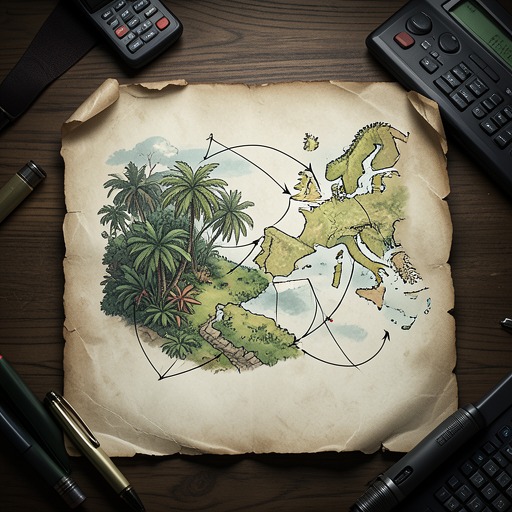
The river’s relationship to the Mekong is made explicit in the account of the ferry crossing between Vinh Long and Sadec. The ferry crosses a branch of the Mekong, while the larger channel known as the Saigon River carries the liners toward the port. These waterways create a connected spatial network rather than a single isolated setting: local buses and ferries lead toward Saigon, and Saigon leads outward through the port to the China Sea, the Indian Ocean, the Suez Canal, and France.
A Colonial Route to France
The Saigon River is the point at which the colony becomes materially connected to Europe. Once the liners berth, passengers can dine and dance as though already in France, although the expense makes that access unavailable to the narrator’s mother. The river thus distributes mobility unequally. It offers international passage, but class determines who can use it, and social rules determine who can appear there without danger.
The ships of Messageries Maritimes make the route between Indochina and France possible. Their voyages last twenty-four days, and the liners function like floating towns, containing streets, bars, cafés, libraries, drawing rooms, meetings, lovers, weddings, and deaths. The Saigon River is consequently both an infrastructural corridor and the beginning of a social world organized by temporary encounters. It carries colonial subjects toward France while preserving the distance, cost, and hierarchy that define colonial travel.
The River and the Lovers
The river is linked to the first encounter between the Narrator and The Lover from Cholon. The encounter occurs on a ferry crossing the Mekong system, but the broader river network gives the meeting its historical and spatial force. The Narrator is a fifteen-and-a-half-year-old girl traveling through the colonial landscape; The Lover from Cholon is a Chinese man whose wealth comes from property in the colony. Their meeting takes place in a world shaped by migration: she is separated from France by a generation, while he is separated from China by several generations.
The river makes their relationship possible by bringing their routes together, but it also reveals the barriers surrounding it. Their affair crosses racial, familial, legal, and economic boundaries. He belongs to a small group of financiers of Chinese origin who own working-class housing in the colony, while she comes from a poor French colonial family. Their later movements through Saigon and Cholon depend on cars, buses, ferries, and urban routes, yet none of these forms of mobility can overcome the social prohibition against their future together.
The Saigon River also marks a form of exclusion within the relationship. The Lover from Cholon could have traveled on the liners and gone to France, but he feared being seen with the very young white girl. The river therefore does not simply carry people toward freedom; it exposes the surveillance imposed by colonial racial hierarchy and the Chinese-white marriage taboo. Passage is physically available before it is socially permissible.
Departure and the River’s Sound
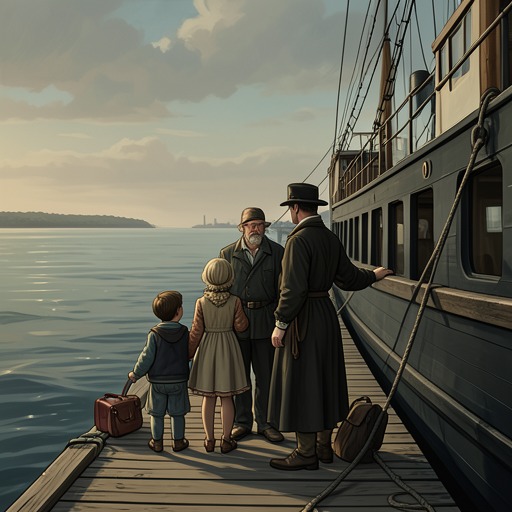
The final departure is staged through the Saigon River and the port. When the ship is due to sail, it gives three long blasts on its siren. Tugs draw it into the middle of the river, release their cables, and return to harbor. The ship sounds another farewell, and its cries make not only the departing lovers but also bystanders and people with no particular attachment weep. The river transforms a private separation into a public ritual.
The Narrator watches from the rails while The Lover from Cholon remains in his long black car near the Messageries Maritimes car park. She recognizes the car and the almost invisible figure inside it; then the car disappears, followed by the harbor and the land. The river is thus the space in which visual contact weakens and ends. Its width converts the lovers’ inability to remain together into a physical vanishing point.
Afterward, the voyage extends the river’s departure into a sequence of seas and canals: the China Sea, the Red Sea, the Indian Ocean, the Suez Canal, and finally the ocean between distant landfalls. The river is the first stage of a passage from Indochina to France, but it contains the emotional pattern of the entire voyage. Once the ship leaves its bank, the relationship enters memory rather than shared geography.
Memory, Return, and Significance
The Saigon River remains active in recollection long after the departure. It connects the remembered affair to the later telephone call in which The Lover from Cholon reaches the Narrator in Paris and says that he still loves her and will love her until death. The call reverses the direction of the earlier passage: the former lover, once left behind in the colony, reaches across time and distance through his voice. Yet the river’s separation has not been erased; the reunion occurs through memory, language, and the telephone rather than physical return.
The river’s significance also extends beyond the lovers. The Narrator’s later writing transforms colonial waterways and departures into literature, while the work’s larger movement between Indochina, France, film, and memory turns local geography into a world-literary passage. In this structure, the Saigon River is a threshold between childhood and adulthood, colony and metropole, desire and loss, and lived experience and artistic creation. It joins places that history has connected, but its current also carries people away from one another, making connection inseparable from departure.